 MOON
Checked 2026-10-29 · Patch 1.0.5 · Sources linked at the bottom of this page.
Moon Sweepers Automation: Ratios, Flow Layout and Robots
Independent Moon Sweepers guide by mooncleaning.net.
A one-chamber, two-press line is a source-based starting option, not a measured best layout. It requires 40 kg of incoming dust per minute and 46 kW to make up to 40 kg of stone per minute. The tables separate theoretical ratios from single-source belt/robot specifications and official 1.0.5 changes.
Evidence: Wikily and the 28 October IndiaTimes ratio guide agree on chamber/press cycles, ratios and power. Independent derivation by the second writer cannot be established. Exact belt speed, capsule spacing, robot prices and solar specifications remain Wikily single-source figures, generally in its 1.0.4 data set.
Machine inputs and outputs
| Machine | Price | Power | Input / output rate |
|---|---|---|---|
| Pressure chamber | $500 | 10 kW | Up to 5 kg dust each 12 s -> same mass of sand; 25 kg/min maximum |
| Stone press | $1,000 | 18 kW | 1 kg dust + 1 kg sand each 6 s -> one 2 kg stone; 20 kg stone/min |
| Packager | $100 | Not stated here | Wiki: 100 kg store; one 1 kg capsule per 0.35 s |
| Conveyor | $0.50/m | Not stated here | Wiki: 1.1 m/s, 0.75 m spacing -> 88 capsules/min |
| Splitter / merger | $5 each | Not stated here | Wiki: one input/two outputs; two inputs/one output |
| Capsule catcher | $1,500 | Not stated here | Wiki price; official 1.0.4 increased store to 100 kg |
Five chamber-to-press ratios
| Chambers : presses | Machines cost | Raw dust/min | Stone/min ceiling | Rated power | Limit |
|---|---|---|---|---|---|
| 1 : 1 | $1,500 | 20 kg | 20 kg | 28 kW | Throttle chamber to 10 kg sand/min if no surplus is wanted. |
| 1 : 2 | $2,500 | 40 kg | 40 kg | 46 kW | 20 kg dust to sand; 20 kg bypasses chamber. |
| 1 : 3 | $3,500 | 50 kg | 50 kg | 64 kW | Sand-limited: the three presses cannot all run at full rate. |
| 2 : 4 | $5,000 | 80 kg | 80 kg | 92 kW | 40 kg sand/min used; chambers have spare capacity. |
| 2 : 5 | $6,000 | 100 kg | 100 kg | 110 kW | 50 kg sand/min; no chamber headroom. |
Static 1:2 flow layout
| Line | Flow | Design requirement |
|---|---|---|
| Incoming dust | Collector supply / catcher -> splitter | 40 kg/min total for the 1:2 stone target. |
| Sand branch | 20 kg dust/min -> pressure chamber -> sand distribution | Supply each press with 10 kg sand/min. |
| Raw branch | 20 kg dust/min -> raw-dust distribution -> both presses | Supply each press with a separate 10 kg dust/min stream. |
| Output | Press A + Press B -> merged stone belt -> station intake | Combined 40 kg stone/min = 20 blocks/min; keep the output clear. |
| Power | Generation / storage -> chamber + both presses | 46 kW rated machine demand, with separate planning for night storage. |
Solar power and belt constraints
| Panel | Price | Peak generation | Battery |
|---|---|---|---|
| Solar post (S) | $75 | 3 kW | None |
| Solar twin (M) | $150 | 7.5 kW | 4 kWh |
| Solar tracker (L) | $300 | 16 kW | 10 kWh |
Wikily's belt arithmetic is 1.1 / 0.75 × 60 = 88 capsules per minute. A 0.35 s machine outfeed is about 171 units per minute, so one belt can be the bottleneck. Capsule count is not kilograms: a 2 kg stone block and a 1 kg dust capsule carry different mass. Wikily also reports machines stop below 8% of required power; that threshold has no second source here.
Robot choices before and after J.O.O.N.A.S.
| Robot | Price | Work area | Bin | Width |
|---|---|---|---|---|
| Robot vacuum Mk I | $250 | 19 hexes | 15 kg | 1.3 m |
| Robot vacuum Mk II | $500 | 37 hexes | 40 kg | 2.4 m |
| J.O.O.N.A.S. | $20,000 | Whole Moon | 60 kg | 5.6 m |
What changed in 1.0.5 (official single source): build on dusty ground; move pieces with R; full piece-removal refund. J.O.O.N.A.S. targets the emptiest catcher in the nearest group within 100 m, then the next group when all in the first exceed 80%. The same patch raises the world capsule ceiling to 90,000. None of these details was inferred from a gameplay video.
For the value of the finished stone, use sale versus added value; for prerequisites use upgrade costs. Also see beginner steps and official patch summary.
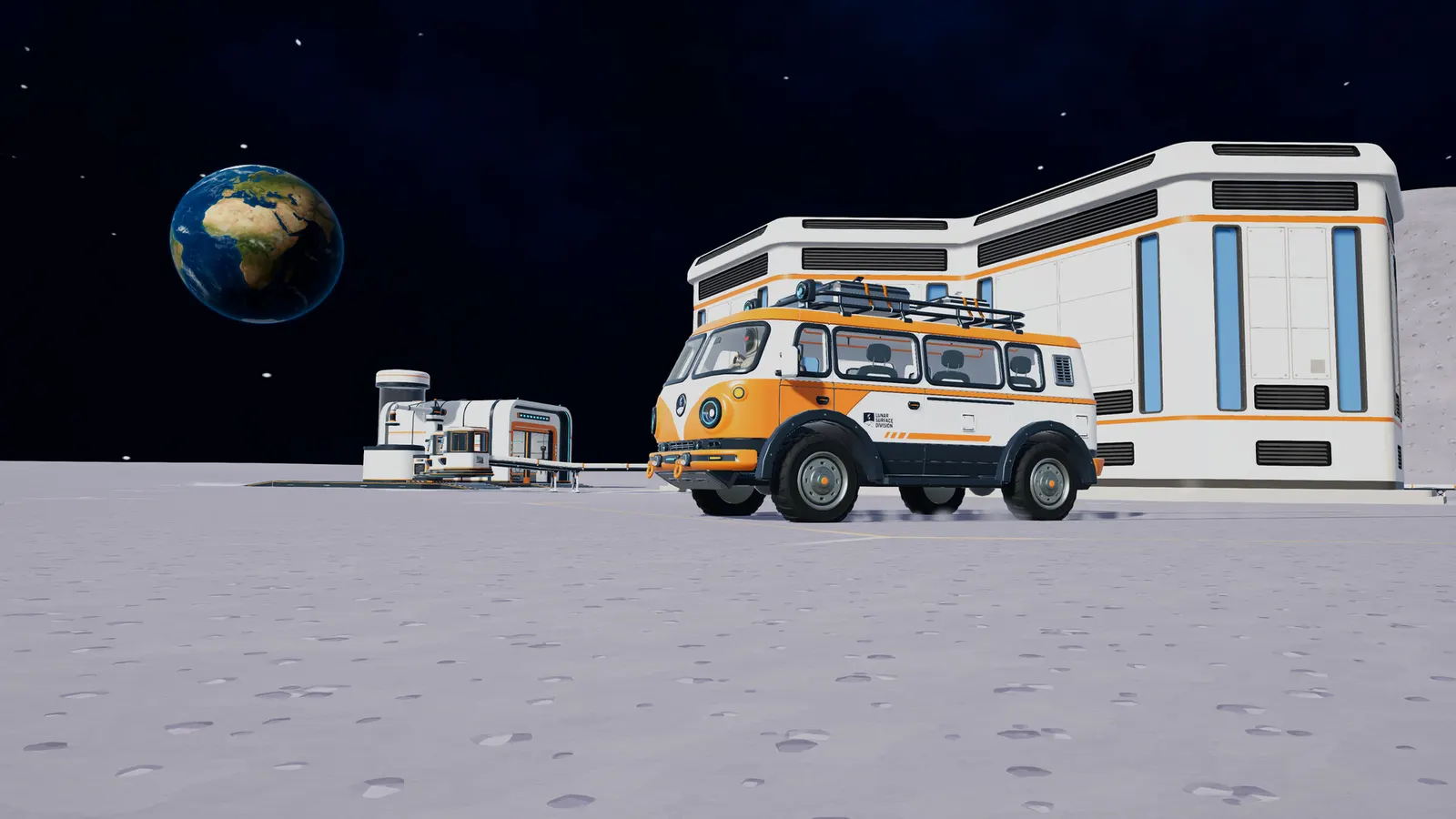
VEHICLES AND AUTOMATION | Moon Sweepers Part 2. Published . Single source: YouTube metadata, checked 2026-10-29; not a gameplay-verification claim. The player loads only after this click.
Questions people type
What is the pressure chamber to stone press ratio?
One chamber makes 25 kg of sand a minute in the 1.0.4 wiki. One press needs 10 kg of sand a minute, so the math is 2.5 presses. A 1:2 line leaves slack. A 2:5 line uses the sand and has none.
How fast are conveyor belts?
Wikily lists 1.1 m/s and 0.75 m spacing, about 88 capsules a minute. A packager can try to emit faster than that. The belt is the limit.
What did 1.0.5 change for J.O.O.N.A.S.?
Official 1.0.5 notes say J.O.O.N.A.S. chooses the emptiest catcher in the nearest group (catchers within 100 m); it switches groups when all are over 80% full. These thresholds have one official source, not two independent confirmations.
Sources
- Wikily machines — Cycle times and power. Labeled 1.0.4.
- Wikily production chains — Ratio math.
- Wikily J.O.O.N.A.S. — Price and capsule behavior.
- Steam 1.0.5 — Catcher spreading and build-anywhere. 2026-10-28.
- IndiaTimes ratio guide — HTTP 200; five-ratio costs/output/power and split dust requirement. Published 2026-10-28.
- Wikily buildings — Single-source machine prices; its 75% removal rule is superseded by official 1.0.5.
- Wikily selling and income — Single-source capsule masses and machine stores.
- YouTube video metadata — Single-source YouTube watch metadata checked 2026-10-29; upload 2026-10-27T11:26:18-07:00. Title/date only, not full viewing or gameplay validation.